Open Subsidiary vs. Branch in Portugal
Compare a subsidiary and a branch in Portugal: independence from the parent company, registration and liability. Ask our lawyers which option suits you.

Investors who want to open a permanent establishment can choose between a branch and a subsidiary in Portugal. The main difference between the two business forms is their level of independence from the parent foreign company. The decision of opening a subsidiary or a branch can depend on a number of factors, such as the operations the company will undertake in Portugal, the available capital at the time of the incorporation, etc. One of our lawyers in Portugal is able to provide you with detailed information on the business options and the legislation for foreign investments, updated for 2026.
Key differences between the branch and the subsidiary in Portugal
The branch and the subsidiary are both suitable manners in which a foreign company can start doing business on the Portuguese market, but their key differences can be important for some corporations. Below you can find out some of the defining individualities for these two business forms, with the mention that legal support can be offered for any kind of incorporation:
| Characteristics | Branch | Subsidiary |
| Independence | The branch is not an independent legal structure. The parent company abroad will be liable for its debts and obligations in the Portuguese city in which it operates. | The subsidiary is a separate legal entity, a resident Portuguese company that operates independently from the parent company, although it still operates in the same business field as the foreign company. |
| Incorporation | It is generally accepted that the branch needs to comply with fewer requirements for incorporation.The parent company still needs to register it but it will provide its own Articles of Association and the decision for incorporating the branch in Portugal. | The subsidiary is incorporated as any local Portuguese resident company. The founders need to go through all of the company formation steps. |
| Regulation | The branch observes the Portuguese corporate laws although it will have a slight advantage in terms of accounting and reporting: this process is less complex for resident companies. | The subsidiary complies with the Portuguese business and company laws, observes the Portuguese GAAP accounting principles and files its financial statements on an annual basis. |
| Taxation | The branch is subject to the same corporate income tax rate as any other resident company, although only for the income derived from Portugal. The provisions of the double tax treaties will apply. | The subsidiary is a resident company taxes on its worldwide profits (business income, passive income as well as capital gains). |
The branch in Portugal
The Portuguese branch is essentially an extension of the parent company. It is a non-resident business without a separate legal personality in Portugal. The branch can only perform the same activities as the parent company and must share a common name. Here are extra details to consider about branches in Portugal:
- The foreign company controls the management of a branch established in Portugal.
- An advantage of the branch is that it requires no minimum share capital at the time of the incorporation.
- The parent company will be fully liable for its debts and obligations in Portugal.
- The branch is subject to taxation in Portugal: it pays the corporate income tax on profits derived from the country and VAT on sales.
- The registration of the branch in Portugal is performed by means of a resolution from the parent company.
The subsidiary in Portugal
A subsidiary is a separate legal form from its parent company overseas. It is a resident Portuguese company, most commonly a private limited liability company. Below is information about this entity, which can be easily established in Portugal:
- The subsidiary is completely independent of the mother company.
- The connection between the two corporate entities is reflected in the share ownership.
- The limited liability company is registered with the Portuguese Commercial Registry.
- There are no mandatory minimum capital requirements for this type of company in Portugal.
- A subsidiary can have one or more shareholders (single-member LDAs are allowed), each holding a quota of at least one euro.
Conditions for registering a company in Portugal in 2026
A private LDA can be the proper structure for establishing a subsidiary in Portugal in 2026, and specific conditions need to be respected. The declaration of opening a subsidiary or a branch in Portugal is normally issued by the parent company. Each structure needs to be registered with the tax authorities in Portugal, and also for paying the social contributions for the employees. Legal advice for business registration in Portugal can be solicited from our team of lawyers in Portugal at any time. They can also help you register the company for VAT.
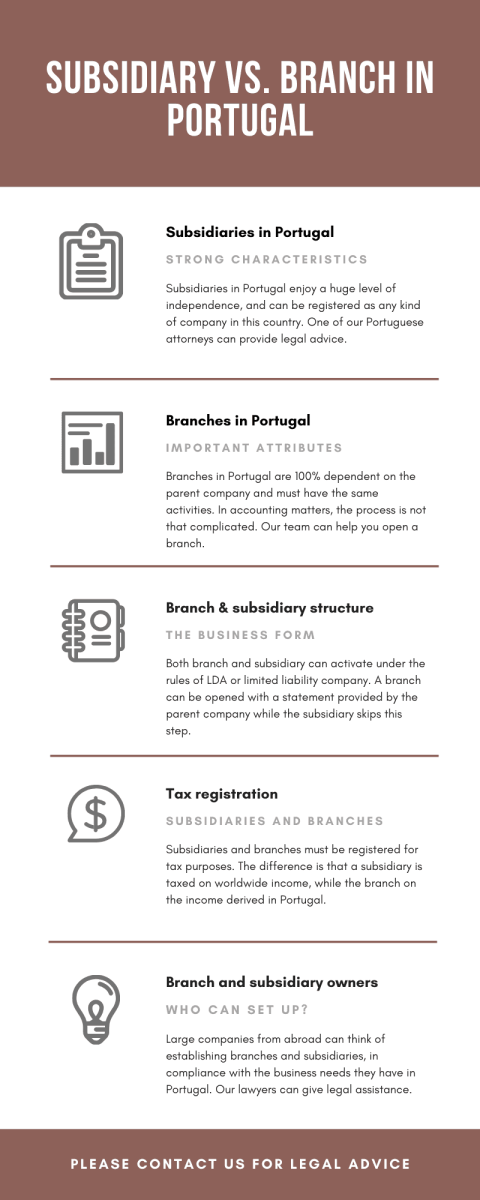
Who can set up branches and subsidiaries in Portugal?
International companies can easily establish branches and subsidiaries in Portugal if these are considered proper business structures for their future operations in this part of Europe. For instance, for 100% independence, a subsidiary can be the ideal form of business in Portugal, with the mention that such a structure can have other activities too. On the other hand, branches are limited to the operations and the liability of parent companies from abroad, which might represent an impediment for those type of entrepreneurs looking for individuality in terms of business. In any case, one should be assisted from a legal point of view by our Portuguese attorneys and find out more about the formalities involved for opening such structures.
Appointing our attorneys as your representatives in Portugal
Whether you choose to form a branch or a subsidiary in Portugal, you need to respect one of the important conditions of having a legal representative. This is where our lawyers in Portugal can provide support, as they may act as representatives for your firm, with the help of a power of attorney. Feel free to ask us any questions in this sense, and look for complete support for opening a branch or a subsidiary in Portugal. Also, if you are interested in obtaining the EORI number, please talk to our advisors.
Corporate taxation and tax benefits in Portugal
In mainland Portugal, the standard corporate tax rate stands at 19% (2026). Madeira Island, as an Autonomous Region of Portugal, establishes its own corporate tax rates, with the standard rate set at 13% (2026), representing a reduction compared to the mainland Portugal rate. This renders Madeira an appealing choice for businesses seeking a tax-friendly environment.
Beyond its competitive standard rates, Madeira also provides additional tax incentives through initiatives like the Madeira International Business Center (MIBC), designed to attract foreign investment. The MIBC offers a reduced corporate tax rate of 5% for specific activities and extends other advantages, including exemptions from withholding tax on dividends and interest payments. These favorable conditions further contribute to Madeira’s allure as a strategic location for businesses seeking advantageous tax frameworks.
Business changes in Portugal in 2026t
Do you want to open a branch or a subsidiary in Portugal in 2026? Here are some updates in the business sector that might interest you:
- A substantial development is expected in the technological sector of Portugal in 2026, where over 45,000 new positions will be created in specialized companies. Thus, export revenue of over EUR 6.8 billion is estimated.
- Investments of almost EUR 2.4 billion will be made in the real estate sector of Portugal in 2026. More building permits will be granted to further grow and support the construction sector in Portugal.
- Portugal focuses in 2026 on the export of textiles and manufacturing. Thus, a growth of over 10% is expected in small and medium-sized enterprises in Portugal starting this year.
For more information about how you can open a branch or a subsidiary in Portugal in 2026, plus details about the business options for foreign investors, please contact the experts at our law firm in Portugal.
Gabriel Guimarães Barreto, Attorney at Law · 2 October 2026